Why Making Things Is the Best Education Money Can Buy
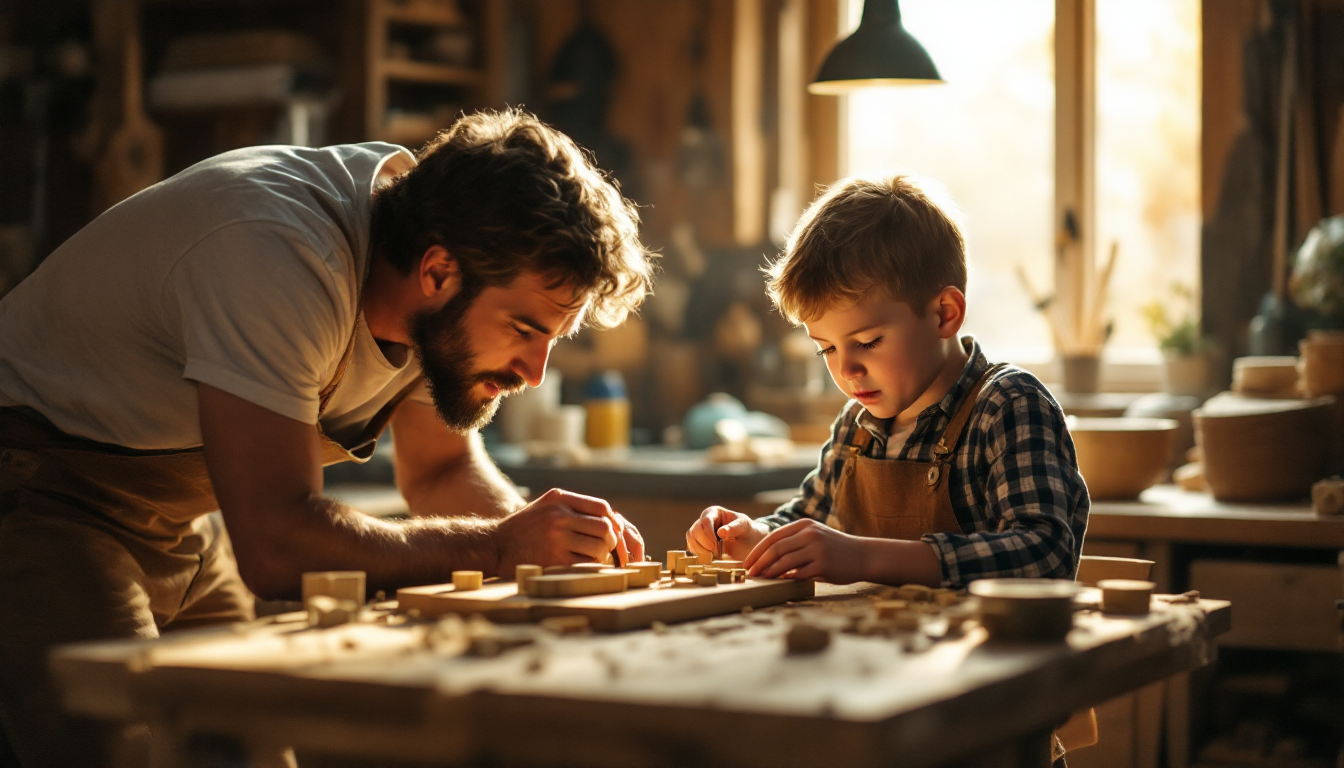
A worksheet can tell your kid that a bridge needs support. A popsicle-stick bridge that collapses tells him something he'll never forget. Here's why building real things teaches what no curriculum can.
I used to think the goal of education was to get information into a kid's head. Read the chapter, answer the questions, confirm the information arrived. That model is clean and easy to grade, and it's most of what school is. It's also, I've come to believe, the weakest form of learning we've ever invented.
The strongest form is older and messier. A kid makes something. It doesn't work. He figures out why. He makes it again. Somewhere in that loop, between the thing failing and the kid fixing it, an education happens that no lecture can reproduce. I didn't learn this from a book on pedagogy. I learned it watching what my kids actually retained versus what evaporated the day after the test.
What a Worksheet Cannot Do
A worksheet operates in a world where there's a right answer and the answer is already known. The kid's job is to find the answer the adult already has. That's a useful skill. It is also a profoundly passive one. The kid is never wrong in a way that matters, never surprised, never up against a reality that doesn't care what he wrote in the blank.
Making something real flips all of that. When a kid builds a circuit, the bulb either lights or it doesn't. When he bakes the bread, it either rises or it's a brick. When he writes the line of code, the monkey either moves or it sits there mocking him. There is no partial credit from reality. The thing works or it doesn't, and the kid has to face that without an adult softening the verdict.
That feedback is the whole point. It's honest in a way a grade never is. A grade is one human's opinion of how close you came to another human's expectation. A collapsed bridge is physics telling you the truth to your face. Kids know the difference. They argue with grades. They don't argue with gravity. And a kid who has spent real time up against gravity, against the stubborn refusal of materials to do what he wanted, develops a relationship with truth that the worksheet kid never gets the chance to.
The Hidden Curriculum of Building
When my kids build something, they think they're learning to build. They're actually learning about six other things at once, and those six things are the real reason I protect making time on our schedule.
- Patience. Real things take longer than you think and fail more than you'd like. A kid who finishes a project he wanted to quit halfway through has practiced something no patience worksheet could teach.
- Sequence. You can't paint the model before you glue it. Building forces a kid to think in order, to plan steps, to understand that some things have to happen before other things. That's the same muscle a kid uses to structure an essay or debug a program.
- Estimation and resourcefulness. You run out of materials. You measured wrong. You improvise. The kid who has done this a hundred times develops a practical confidence that the kid who only ever filled in blanks simply does not have.
- Tolerance for failure. This is the big one. A maker fails constantly, in small recoverable ways, all day long. Failure stops being a catastrophe and becomes just a step. That single reframing is worth more than most of what we test for.
None of those show up on a transcript. All of them show up in the kind of adult a kid becomes.
Why This Is the Heart of Ars Technica
This is exactly why we built the Ars Technica track the way we did. Ars Technica is our hands-on domain, built for dads who never took an art class and kids who want to make things. It teaches the fundamentals of seeing, drawing, and composing, not as tricks to memorize but as a way of training attention. The deliverable isn't a test score. It's a completed sketchbook and a capstone piece your kid made with his own hands.
We designed it deliberately around making rather than consuming. There's no two-hundred-dollar supply list and no dedicated art room required. Roughly $30 to $40 of materials from any craft store, a couple hours on a Saturday, and a ten-minute conversation with your kid afterward. The conversation is part of the curriculum, because making the thing is only half of it. Talking about why it came out the way it did is where the kid learns to see his own process.
What I love about a making-based track is that it can't be faked. You can't skim a chapter and bluff your way through a drawing. The page is either honest or it isn't, and the kid knows. By the end, a kid finishes with something real he can hold, and you finish having had eight conversations with him you wouldn't have had otherwise. That's the trade I'll take every time over another stack of completed worksheets.
The Faith Angle
We worship a God who is, before anything else in the story, a maker. The very first thing Scripture tells us about Him is that He builds. "In the beginning God created the heavens and the earth" (Genesis 1:1). And when He makes us in His image, the first job He hands us is to tend and cultivate a garden, to take raw creation and shape it into something more. We are made by a maker, in the image of a maker, and given the work of making.
So when a kid sits down to build something with his hands, he is doing something deeply human and quietly holy. He is exercising the part of him that most resembles his Creator. There's a reason a child glows when he holds up a thing he made and says, "Look what I did." That glow is not pride in the cheap sense. It's the satisfaction of having done the work he was made to do. Our culture trains kids to be brilliant consumers, expert at choosing between things other people made. Making turns that around. It teaches a kid that he is not just here to select from a menu. He's here to add something to the world that wasn't there before.
Picture the most ordinary version of this. A kid sets out to build a bridge from popsicle sticks and glue, the kind of project that shows up in every science fair. The first one looks great and folds the moment you set a book on it. He's frustrated. He wants to be done. But if you can get him to ask why it failed, something shifts. He notices the deck had no support underneath. He adds a truss. The second bridge holds the book, then two books, then a small stack before it gives. Nowhere in that process did anyone hand him the answer. The bridge taught him. That loop, build, fail, look closer, build again, is the engine. It works the same whether the thing is a bridge, a loaf of bread, a wobbly birdhouse, or a line of code that finally runs. The material changes. The lesson doesn't.
Where to Start This Week
You don't need a curriculum to start. You need a project with a real outcome. Build a birdhouse. Bake bread from scratch and let it fail before it succeeds. Wire a simple circuit. Plant a garden bed and keep it alive. Pick anything where reality, not a parent, gets the final say on whether it worked.
Then resist the urge to rescue. The instinct to step in the moment your kid struggles is the instinct that quietly robs him of the lesson. Let the bridge fall. Let the bread flop. Sit with him in the disappointment for a minute, and then ask the only question that matters: what would you change next time? That question, asked over a thing your kid actually made, is the best education money can buy. And most of the time, it costs almost nothing at all.
If you want a structured path into hands-on learning, our Ars Technica track is built exactly for this. Or start with our free Week 1 lesson and see how making changes the way your kids learn.