The One Spiritual Habit That Outlasts Everything Else
Your kids will forget most of what you teach them. Here's the one repeated practice that survives long after the worksheets are recycled, and why it matters more than any academic milestone.
There is a moment most homeschool parents hit somewhere around year three. You look at the binders, the curriculum you spent a summer choosing, the reading logs and the math drills, and you ask a quiet question you don't say out loud at co-op. What of this will actually last?
It's a fair question. Most of it won't. I don't mean that cynically. I mean it the way any honest teacher means it. The specific facts fade. The grammar rules blur. The state capitals come and go. I was a kid once who could name every bone in the human hand for a test, and I could not name three of them today. That isn't a failure of education. It's simply how memory works. We retain almost nothing in detail and a great deal in shape.
So if the details fade, the real question becomes which shapes are we leaving behind. What survives the forgetting?
For years I assumed the answer was something academic. The ability to read well. The habit of writing clearly. Maybe the discipline of sitting with a hard problem. Those are good things, and they do last longer than facts. But they're not the thing that lasts longest. The thing that outlasts everything else in a child's formation is not a skill at all. It's a repeated act of devotion that they watched happen, day after day, until it became part of how they understand the world.
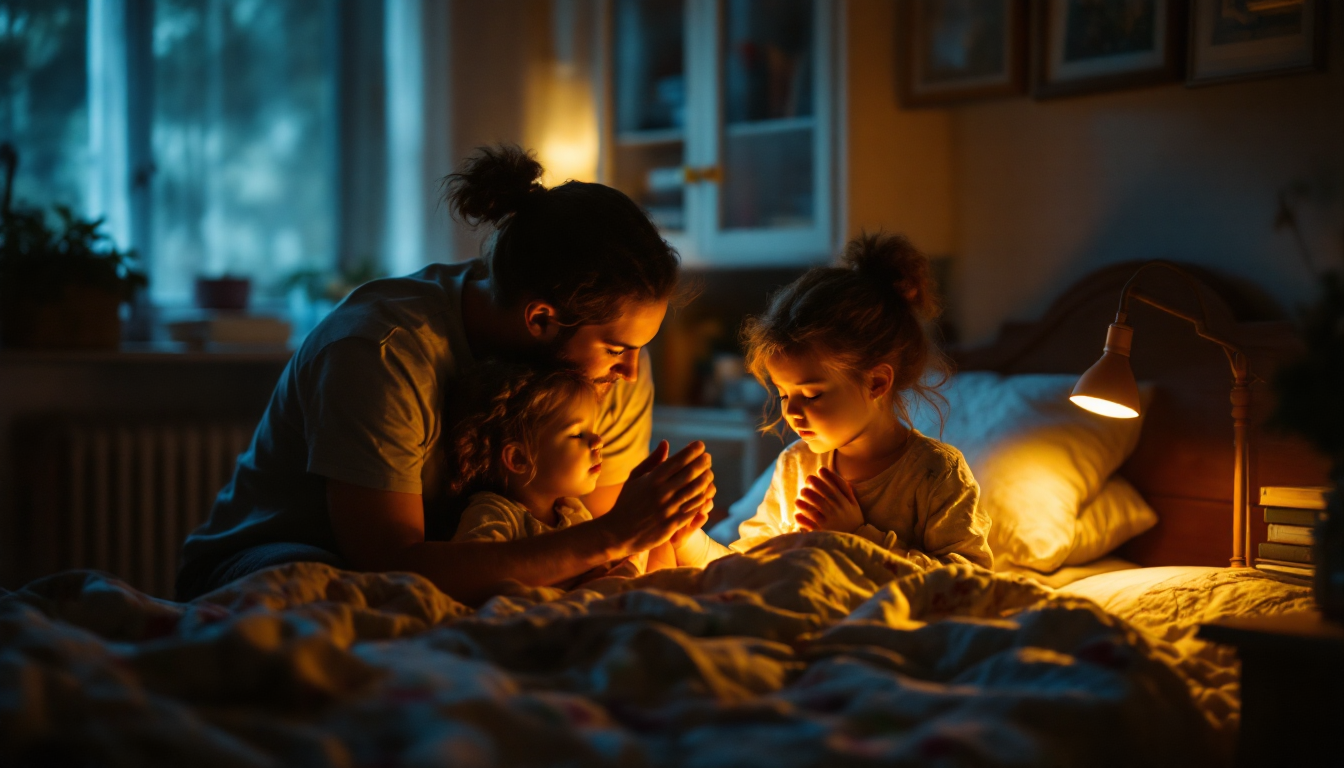
For us, it's bedtime. Every night, before the lights go out, we pray together as a family and we sing the Doxology. "Praise God from whom all blessings flow." Same words, same tune, night after night, year after year, until it's as much a part of the day as turning off the lights.
That habit, the nightly prayer and the Doxology, is the one I'd protect before any subject on the schedule.
Why Repetition Beats Achievement
We are wired to chase the milestone. The reading level. The test score. The completed module. There's nothing wrong with those, but they share a weakness. They are events. They happen once and then they're done, and a child files them under "things I accomplished" rather than "things I am."
A repeated formation habit works differently. It doesn't announce itself. It accumulates. A kid who prays with his family every night for ten years has prayed somewhere north of three thousand times before he leaves the house. He didn't decide to become a person who prays. He simply became one, the same way he became a person who brushes his teeth. The habit got under the skin before he was old enough to argue with it.
That's the part most of us miss when we think about discipling our kids. We imagine the big conversation, the moment we sit them down and explain what we believe and why. Those conversations matter. But they are not what forms a child. What forms a child is the ten thousand small repetitions that happened before and around the conversation. The conversation only names what the repetition already built.
Achievement says, "Look what you did." Habit says, "Look who you are becoming." Only one of those is still working when your kid is twenty-five and standing over a crib of his own deciding how his family will end the day.
What the Habit Is Actually Teaching
Here's what surprised me once I started paying attention. The content of the habit matters less than the fact of it. I don't mean the words of a prayer are unimportant. I mean that a child absorbs the meta-lesson long before he absorbs the literal one.
When a kid watches his parents stop the machinery of a busy day to do one quiet, unhurried thing that has no productive output, he learns something that no lesson could teach him directly. He learns that some things are done not because they work but because they are true. He learns that his parents answer to something higher than the schedule. He learns that the most important parts of a life are often the parts that look, from the outside, like they're getting nothing done.
That lesson is the soil everything else grows in. A child who believes the world is governed only by output and achievement will treat his faith as one more box to optimize. A child who has watched his family stubbornly keep a practice that produces nothing measurable has a category for grace. He knows, in his body before his mind, that worth is not earned by performance.
The Faith Angle
Deuteronomy 6 is the passage every homeschool parent eventually runs into, and it's worth sitting with the actual mechanics of it. "These commandments that I give you today are to be on your hearts. Impress them on your children. Talk about them when you sit at home and when you walk along the road, when you lie down and when you get up" (Deuteronomy 6:6 to 7).
Notice what God does not say. He does not say to hold an annual seminar. He does not say to make sure they pass the exam. He says talk about them when you sit, when you walk, when you lie down, when you get up. He's describing the seams of an ordinary day. The instruction is to take the truth and stitch it into the repeating rhythms of normal life until a child cannot remember a time it wasn't there.
That is the whole strategy. Not intensity. Repetition. God's chosen method for passing faith from one generation to the next was the boring, daily, unglamorous practice repeated so many times it stopped feeling like a practice and started feeling like home. The forgetting that erodes everything else is exactly what repetition is built to survive. You don't remember the ten thousandth time you did something. You just are the person who did it ten thousand times.
How to Build One That Lasts
If you don't have a habit like this yet, start absurdly small. The most common mistake I see (and the one I've made) is launching an ambitious family devotional program in January that collapses by February. A habit that lasts a decade has to be small enough to survive a bad week. Five minutes. One Psalm. A single prayer. Something you can do when you're tired, when the baby is crying, when half the family is in a mood. If it only works on good days, it isn't a habit. It's a hobby.
Tie it to something that already happens. You already eat breakfast. You already put kids to bed. Anchor the new practice to an old one and you skip the hardest part, which is remembering to do it at all.
And then protect it the way you'd protect a load-bearing wall. The schedule will always have a reason to skip it. The reason will always be good. That's exactly why it has to be non-negotiable. The things that form our children are almost never urgent, which is precisely why they get crowded out by the things that are.
I'll be honest about something most articles on family devotion leave out. Most nights, it doesn't feel like much. We pray and we sing the Doxology, and a fair number of nights it feels rote. Kids are tired. Somebody's cranky. The singing is half-hearted. There are evenings I'm tempted to skip it because nobody seems to be getting anything out of it, including me.
But the rote nights are not the failure of the habit. They're the whole point of it. A practice you only keep when it feels meaningful isn't a practice. It's a mood. The value of a repeated rhythm is precisely that it keeps going on the nights it feels like nothing, because formation doesn't happen in the moments that feel powerful. It happens in the accumulation, in the thousands of ordinary repetitions that no one will remember individually. The same words on the good nights and the flat ones is what tells a child this is not contingent on feeling. It is simply what we do. It's true whether or not anyone is moved by it tonight.
So I've stopped measuring the habit by how it feels in the moment. I measure it by whether we did it. On that count, the unremarkable nights count exactly as much as the good ones.
Years from now, your kids will not remember the curriculum you agonized over. They will not remember the year you did Apologia versus the year you did something else. But they will remember the shape of their evenings. They will remember the song their family sang before the lights went out. And if you've done it right, they won't just remember it. They'll be doing it too, over a crib you've never seen, with kids you haven't met yet. That's the only lesson plan that survives the forgetting.